
Why a Beautiful Building and a Beautiful Painting Aren't Measured the Same Way
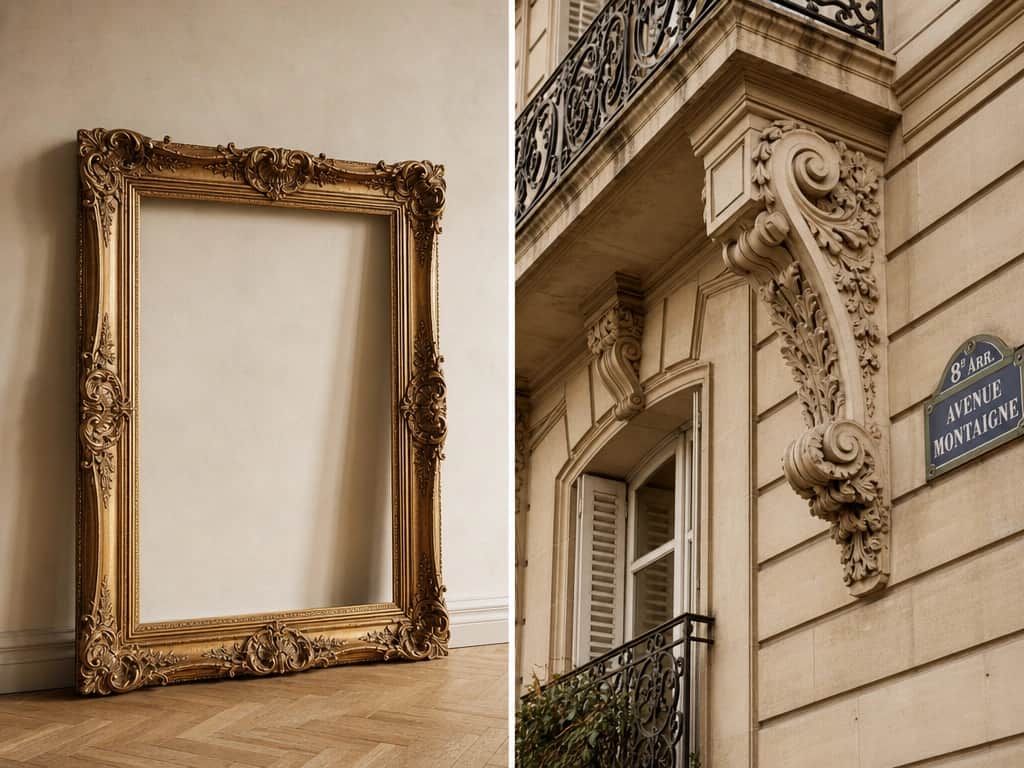
Picture two things you have called beautiful this week. Maybe a painting in a museum, maybe the front of an old building you walked past. It feels like the same word should mean the same thing in both cases. New research suggests it does not. The qualities that make a facade strike us as elegant are not the qualities we reward in a canvas, and the difference is measurable.
The work comes from Norberto M. Grzywacz at Loyola University Chicago, along with Consuelo M. Correa and Ivan Correa-Herran, published in Psychology of Aesthetics, Creativity, and the Arts [1]. Their argument is that aesthetic value is not one general setting in the mind. Instead, the visual system seems to keep separate ledgers for separate categories of things, and it applies different accounting to each.
To test this, the team did something unusually concrete. Rather than asking people to rate pictures and chasing the noise in those ratings, they ran computational analyses on the images themselves. They examined 55 photographs of building facades in Paris and 142 paintings from 61 artists, all drawn from roughly the same window of history, the mid-to-late nineteenth century [1]. Holding the era and the city steady matters here. If you compare a Gothic cathedral to a modern abstract, of course they differ. By keeping the period fixed, the researchers could ask a sharper question: when two art forms share a culture and a moment, does the brain still grade them on different curves?
It does, at least according to the visual statistics. The buildings came out consistently more complex than the paintings on several measures of how much information an image packs in. They also showed far more balance and symmetry, stronger repeating patterns across space, and a heavier reliance on strict vertical and horizontal lines. Think of a Haussmann-era apartment block: rows of identical windows, a flat insistence on the grid, an order you could almost set a ruler against. Paintings from the same Paris allowed themselves to be looser. They tolerated asymmetry, broke up their patterns, and let diagonal and curved lines wander where a building would never permit them.
What does that tell us about the mind rather than the masonry? Grzywacz frames it as evidence that even within a single sense, vision, the brain files aesthetic preferences in distinct drawers. "Even inside one modality, namely vision, different values are stored separately," he says. The point he keeps returning to is context. "When we say that something is beautiful, the context of what we are seeing matters." We do not run buildings and paintings through one universal beauty detector. We seem to know, before we have consciously decided anything, what kind of object we are looking at, and we summon the standards appropriate to it. That capacity for context-dependent categorisation draws on the same broader cognitive flexibility that, in a very different domain, lets a literate brain recruit extra neural territory when listening to unfamiliar speech.
There is an intuitive logic to this once you sit with it. A building has to stand up. It has to be entered, lived in, walked past a thousand times without becoming exhausting. Order, symmetry and clear lines are not only pleasant in a facade; they signal stability and make a large structure legible at a glance. A painting carries none of that burden. It can afford to surprise, to unbalance you, to reward the long second look. If our preferences were shaped partly by what each kind of object is for, you would expect exactly the split the study found.
Now the caution, because the study earns a careful reading rather than a sweeping one. The most important limitation is that no human beings were tested. The researchers measured properties of the artworks and buildings, not the brain responses of people viewing them. So when we talk about what "the brain" does, we are inferring it from the finished objects, on the assumption that creators across a culture converged on what audiences found beautiful. That is a reasonable assumption, but it is an assumption. A study using eye-tracking or neuroimaging on living observers could confirm or complicate the picture.
The sample is also narrow by design. Everything came from a single city in a single stretch of years, Paris between roughly 1853 and 1870. That control is a strength for isolating the comparison, but it is a weakness for generalising. Whether the same gap between architectural and pictorial taste holds for Renaissance Florence, Baroque Rome, or contemporary Tokyo is an open question. Cultural specificity could be doing some of the work that looks, from this distance, like a universal feature of perception.
Even with those caveats, the core finding is a useful corrective to a tidy idea. We tend to talk about beauty as if it were a single dial in the head, turned up or down by whatever we happen to see. This research points toward something more compartmentalised. The mind appears to ask, first, what kind of thing is this, and only then decides what beauty would mean for something of that kind. The same eyes, the same word, and underneath them, more than one rulebook. That compartmentalisation has parallels in persuasion research too — just as the brain applies category-specific rules to art versus architecture, people respond very differently to extreme arguments depending on how the claim frames their existing beliefs. For more cognitive science coverage, see the full category.
Sources
- Grzywacz, N. M., Correa, C. M., & Correa-Herran, I. (2024). Domain-Specific Aesthetic Values: A Comparison of Paintings and Architecture. Psychology of Aesthetics, Creativity, and the Arts. https://doi.org/10.1037/aca0000718
This article summarizes published research for general informational purposes only and does not constitute professional advice.
Frequently asked questions
- What visual differences did the study find between the Parisian buildings and the paintings?
- The buildings showed consistently higher complexity, greater symmetry and balance, stronger repeating spatial patterns, and a stronger reliance on vertical and horizontal lines. The paintings from the same era tolerated more asymmetry, broke up their patterns more freely, and allowed diagonal and curved lines that a building would not permit.
- Were real viewers tested in this study, or only the artworks themselves?
- Only the artworks were analyzed. The researchers ran computational measurements on 55 building facade photographs and 142 paintings; no human participants were asked to rate or view them. The conclusions about viewer preference are inferences from the objects, not directly measured brain responses.
- How broadly do these findings apply beyond Paris in the mid-to-late nineteenth century?
- The authors held the era and city constant specifically to sharpen the comparison, but that same control limits generalisation. Whether the same gap between architectural and pictorial standards holds for other cultures, periods, or styles remains an open question the study was not designed to answer.
Comments (6)
Priya
Beauty as bureaucratic act. That phrase is going to live in my head.
Tom
The researchers measured the artworks themselves — not anyone's brain responses — then concluded the visual system uses separate evaluation channels for paintings versus buildings. That's a significant leap. Assuming nineteenth-century Parisian creators accurately tracked public taste ignores that avant-garde work was routinely rejected in exactly that period. The compartmentalization hypothesis is genuinely interesting, but I wish the article hedged harder on that inferential step.
Leila
My mother grew up in Tehran, and whenever we walked Haussmann-era streets in Paris she would get tense in a way she couldn't explain. She loved the Impressionist galleries two blocks away. I always attributed it to the scale feeling inhuman. Reading about strict vertical repetition making a large facade legible at a glance, I wonder now if she was being processed — beauty as a sorting mechanism rather than an invitation.