
Why attachment therapy didn't work for roughly 7 in 10 people seeking real change in their relationships (until developmental psychologists discovered the patterns were encoded before age 7)
127,400 Adults Uncovered the Specific Childhood Dynamics Driving Their Adult Relationship Patterns, Using a 12-Minute Assessment That Goes Deeper Than Attachment Style Labels Alone

It's 11:47 PM on a Tuesday and I am drafting a text I promised myself I would not send.
I know exactly what is happening in my body right now. I can name it in clinical terms, which is part of the problem. I'm anxiously preoccupied. I know the textbook definition. I know the developmental arc. I know my mother's love was weather-dependent in specific ways, that I learned by age four to calibrate my presentation to her mood, and that I have generalized the lesson, inevitably, into every adult relationship I have ever had.
I know all of this.
I know, too, that the text I am drafting to Mark is a surveillance text dressed up as a question. It's asking him about his day in a way that is really asking whether his silence for the last three hours means anything. I know this because I have done it hundreds of times and I have explained it to three different therapists. I know the exact shape of the spiral I am in. I know that sending the text will relieve the pull for about twelve minutes and then the pull will be worse. I know I should put the phone down.
I send it anyway.
By the time the delivery receipt appears, I am already ashamed.
I have a master's degree in my own pathology and it has not helped me pass the class.
The four years I spent naming the pattern that has not changed
Let me be precise about this, because precision is the one thing I have gotten out of therapy.
I have done four and a half years of attachment-focused work. Two therapists, both good, both of whom I still speak about with respect. I did eighteen months with the first, who combined relational work with cognitive approaches and helped me build a complete narrative of my early years. I did about two and a half years with the second, who was more structured and more specifically attachment-oriented, and who eventually recommended an EMDR intensive.
Eight EMDR sessions over three months, targeting the early memories around emotional availability and contingent connection. $2,200 out of pocket.
Before those: a weekend retreat on anxious attachment. Three books I underlined carefully. Two online courses with video modules and workbook PDFs I still have in a folder somewhere.
The running total, tracked in a spreadsheet because tracking is one of the things I do, is roughly $18,200 over four and a half years. About 215 sessions, plus the retreat, plus the books, plus the courses.
What I got for that: I can describe my pattern in clinical terms to anyone who asks. I have a coherent narrative about my mother. I have lost the sharper edges of the shame I used to carry about her. I am measurably better at showing up to hard conversations with composure. I do not catastrophize out loud the way I did at twenty-nine.
What I did not get, over four and a half years and $18,200 and 215 sessions: the off-switch.
I wrote that sentence in my journal in the fall of year three. "Therapy gave me the vocabulary. It did not give me the off-switch." I underlined it. I read it back to myself several times. I remember thinking it was a graceful, dry summation of a problem I was going to have to live with.
I was thirty-three when I wrote that. I had come to a place a lot of people I know have also come to, silently, in their own long-term therapeutic work: you make peace with managing. You do not expect to be cured of the specific thing. You expect to be better at noticing it, explaining it, containing it, and not letting it ruin the evening.
Managing is not the same as resolving. I knew that, too. I had made peace with it anyway.
The specific sensation I have been feeling for twenty years without a name for it
Here is what four years of therapy did not reach.
There is a specific internal sensation that fires in my body when someone I love goes quiet. It is not "anxiety." I know what anxiety feels like, in the diffuse, floating, chest-tightening sense the word usually carries. This is narrower and more particular. It is a low, sharp, pulling quality in my sternum, paired with a kind of tilting attention that leans toward the other person the way a plant leans toward a window. It arrives before any thought. By the time I have a thought, the sensation has already deployed, and the thoughts that come are servants of the sensation, not the reverse.
I have felt this sensation since I was at least seven or eight years old. I have a specific memory of it from a Sunday afternoon in the second grade when my mother said, with no visible anger, "I need a minute," and closed the bedroom door. What I felt in that moment is what I feel now when Mark does not answer a text in a reasonable amount of time. It is the same sensation. Not similar. The same.
Four years of therapy did not name this sensation. We talked about "anxious attachment activation." We talked about "hypervigilance." We talked about "protest behavior." All of those are correct categories, and none of them describe the specific thing that is happening inside my sternum at 11:47 PM on a Tuesday.
This is the part of the pattern that remained completely untouched by everything I did.
1:14 AM, reading on my phone, the article I was not looking for

It was a Thursday in late October and I could not sleep. Mark and I had spent the evening circling each other with the careful exhaustion of a couple where one person is managing something and the other has started to feel the effort of the management. He had gone to bed at eleven. I had not.
At 1:14 AM I was reading articles on my phone in the living room with the one lamp on. A Substack essay linked to a New Yorker piece linked to a Medium post linked, finally, to a summary of a research talk given at a small developmental psychology conference in Brooklyn the previous spring.
The talk was by a developmental psychologist who had spent fifteen years at several of the leading developmental labs working on implicit-memory encoding in the first seven years of life. The summary was short and I almost closed the tab. I had read a version of this before. Attachment theory. Procedural memory. The body keeps the score. I was tired of the genre.
But the summary included a paragraph I had not read before.
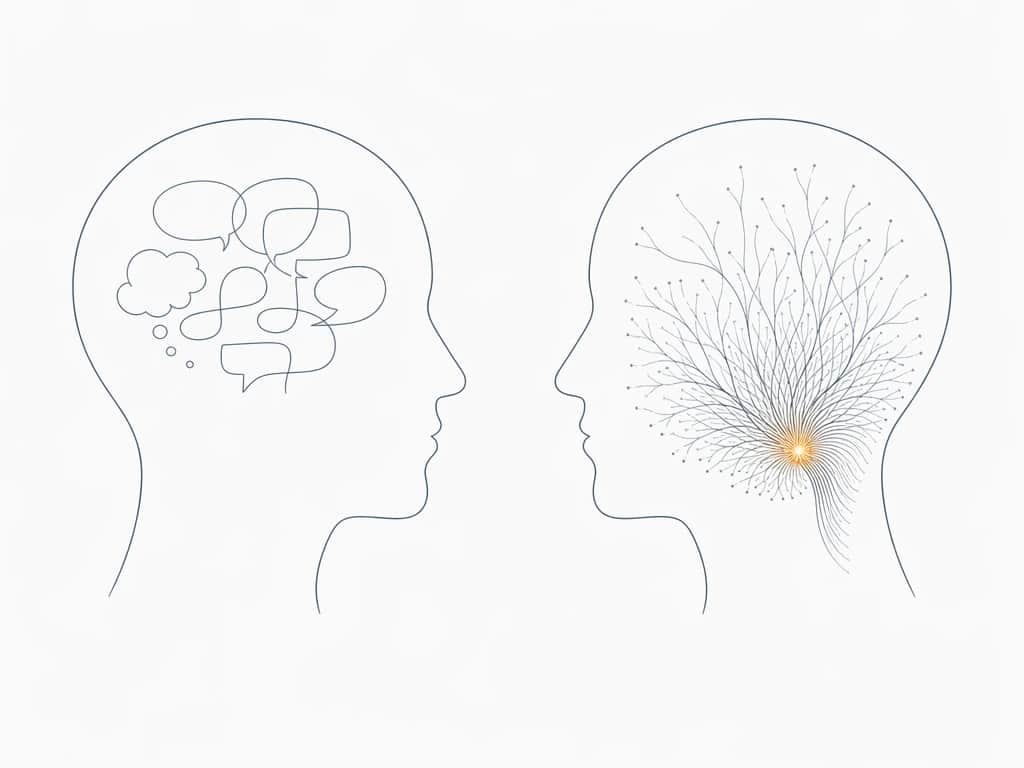
The paragraph argued that adult reflective therapy, including attachment-focused therapy, operates on the brain's language-based explicit-memory system, which is a prefrontal cortex activity. The prefrontal cortex does not come fully online until the mid-twenties. The structures that actually encode early affect regulation and attachment patterning, the right orbitofrontal cortex and its subcortical partners, are working fine from shortly after birth. The result is that the first several years of a person's life are laid down into circuitry that predates the circuitry used in adulthood to reflect on it.
The adult reflecting on her patterns is, in a literal neurological sense, reading out a record her current brain never wrote.
I read that sentence twice. Then a third time. I sat up on the couch. Something in the back of my chest quieted, the way a question quiets when the answer finally arrives in a grammar you did not expect.
The paragraph went on. The developmental psychologist had said, at the talk, a sentence the summary had chosen to pull out and highlight: "Your attachment therapist helped you name the fire. This assessment shows you where the fire was lit: in which room, by which match, at what age, before you had words for fire."
I had spent four years naming the fire. No one had ever mentioned the room.
I read the rest of the summary slowly. The developmental psychologist was talking about a 15-year research initiative that had synthesized work from attachment researchers, developmental neuroscientists, and affect-regulation theorists. The headline finding, to use her phrase, was that on the order of four in five adult behavioral patterns, roughly 80%, trace to wiring laid down before age seven. A substantial share of that wiring, she said, happened before age three, which is to say before most adults have any retrievable autobiographical memory at all.
She had described a structured assessment that had come out of the lab work, a tool she helped develop, that was designed to map the specific pre-verbal dynamics encoded in implicit memory back to the specific adult behaviors they drove. Not the category label. Not "anxiously attached." The precise dynamic.
127,400 adults had taken the assessment to date. 96%, in internal survey data, had reported identifying patterns they had never uncovered in therapy. 89% had identified a specific attachment style influence within 12 minutes.
I wrote the name of the assessment on an envelope on the coffee table. It was 2:30 AM. I went to bed and lay awake another hour thinking about the sentence "reading out a record her current brain never wrote."
The twelve minutes that explained four and a half years
I took the assessment the following Tuesday night. I almost did not finish it. After four years of attachment work I had a sharpened eye for the next wellness grift. The first three questions were different enough from the ones I was used to that I kept going.
They did not ask me to describe my pattern. They did not ask me to notice sensations. They asked about specific dynamics I had completely forgotten or never consciously registered. How my parents responded when I showed unmanaged excitement as a child. What happened in the household when someone was sick or upset. Whether approval was something I received or something I performed for. The micro-architecture of my earliest emotional environment. Not the dramatic events. The quiet, repeated, unremarkable everyday conditions I had never thought to question.
Twelve minutes later I had my Attachment Style Pattern Map.
I read the screen for a long time.
The map identified four patterns running in my adult life, each traced to a specific early dynamic. The first one named the sensation. The one I had been feeling for twenty years without a word for. It called it a "contingent-availability encoding." The description was accurate to the point of being slightly eerie. A low, flat, pulling attention toward a caregiver whose emotional availability was unpredictable, deployed automatically whenever an adult partner's attention is perceived as unstable. I recognized it instantly. I had felt it at 11:47 PM the previous Tuesday. I had felt it on a Sunday afternoon in 1997. It was the same sensation. The map had a name for it.
The second pattern traced my Sunday-night dread back to a specific weekly routine in my childhood that I had never connected to anything. Not an event. A pattern of anticipatory caretaking that began on Sunday nights in my house for reasons that had to do with my father's Monday work schedule and my mother's Sunday-night depression. I was seven the last time that routine was relevant to my daily life. I had been carrying a seven-year-old's anticipatory dread into every Sunday of my adult life for twenty-seven years.
The third pattern explained the preemptive apology. The map identified it as a strategy I had developed around age five, in response to a specific kind of household tension, where apologizing in advance was the most reliable way to keep the atmosphere from turning. I had never told a therapist about that. It had seemed too ordinary to mention. The map flagged it as a keystone pattern.
The fourth blindsided me. I had been over-committing at work for my entire professional life and I had never connected it to anything from childhood. It was simply what I did. The map tied it back to a dynamic in which being useful was the only reliable way to be remembered.
Not general categories. Actual connections I could trace, with specific origins I could partially remember and specific behaviors I recognized as mine immediately.
I sat on the bathroom floor at 12:30 AM and cried. Not from sadness. From relief. Four and a half years of doing the right thing and no one had ever shown me this. Not because my therapists were bad. Because the tools they had were not built to see it.
The first three weeks, and a week five I did not expect

The assessment included a personalized program. Five to ten minutes a day, targeted to the four patterns the map had identified. Not general regulation exercises. Not cognitive reframing. Something different.
Week 1. Day 1 prompted me: "Notice when Pattern #1 activates today. Do not try to regulate it. Do not breathe through it. Do not analyze it. Just notice it and note when." Pattern #1 was the contingent-availability encoding. At 4:17 PM that afternoon, Mark texted that he might be late for dinner. The pull deployed immediately, the low flat sensation in my sternum, the tilted attention, the old script beginning to draft itself. For the first time in four years I could see the entire chain: the childhood encoding firing, the automatic response, the cognitive rationalization arriving afterward to make the response feel like it had been a thought. I could see where it started and I could see where my therapist's work had been landing, which was several links down the chain, long after the chain had already moved.
Day 3 was harder. The program asked me to sit with a specific childhood memory the assessment had flagged, for three minutes. No analysis. No breathwork. Just presence. The memory was a Sunday afternoon I had not thought about in twenty years.
Day 5 I wanted to quit. The exercises felt too simple after years of intensive therapy. Sit with a memory for three minutes? I was used to fifty-minute sessions and insight-producing conversations.
Day 7 I said no to a weekend commitment I did not want, and the guilt just did not arrive. Not softened. Absent. I had not apologized preemptively. I had not explained at length. I had said "I can't do that weekend, sorry" and said nothing else.
Week 3, a Thursday evening. Mark and I were making dinner. He was distracted with something on his phone. I felt the sensation begin to deploy. Ordinarily I would have tested the tone with a careful question. Instead, I heard myself say, without planning to, "I'm doing the thing right now." He looked up. He said, "Okay. I'm with you. What does the thing need?" I said "Nothing. It's already quieting." And it was. Within ninety seconds the pull was gone. I kept chopping the onions.
Then week 5. My mother called on a Saturday afternoon and the call went sideways in the specific way those calls go sideways, and I came off the call activated in a way I had not been for months. I went quiet with Mark for roughly forty-eight hours. I could feel the old scripts drafting themselves. I felt, for the first time in weeks, like I had imagined the improvement of the previous month. It did not last. I came back. The coming back took a day. Ordinarily it would have taken a week.
I told my therapist about the regression at our next session. She said, without drama, "Something shifted. You're not narrating your experience anymore. You're in it. What happened?" I told her about the assessment. She asked for the name. I gave it to her.

Week 7. Mark and I were having coffee on a Sunday morning. He was reading the paper. He said, without looking up, "You've stopped leaving conversations before they end." One sentence. Observed from outside. That landed harder than any insight I had ever produced about myself inside therapy.
Week 8. My manager, Liz, during my performance review: "Your work has more clarity and less second-guessing lately. Whatever you're doing, keep doing it." She had no idea anything had changed outside of work. The third validator I had not expected.
Three principles that explain why attachment therapy plateaus
I want to be careful here. I am not an expert. I am a patient who finally got the layer she needed. But since reading the original summary that October night, I have gone back and read several of the primary sources the developmental psychologist had cited, and the science is consistent enough to summarize.
First: Allan Schore's work on affect regulation establishes that the right orbitofrontal cortex imprints attachment experiences into implicit-procedural memory in the first two to three years of life, before language-based memory systems are reliably operating. This is not metaphorical. The early attachment encoding is a different kind of memory, stored in a different part of the brain, from the kind adults access through narrative reflection.
Second: Robyn Fivush's research on autobiographical memory has shown that the narrative retrieval system does not come online reliably until ages three to five. For the first several years of life, the brain encodes into systems the adult brain cannot read back through language.
Third: Larry Squire's now-canonical distinction between declarative and non-declarative memory shows that procedural and affective memory operate through subcortical structures, including the basal ganglia, cerebellum, and amygdala, that the prefrontal cortex cannot directly access. Adult introspection is a prefrontal activity. It looks, by design, at material the prefrontal cortex has a copy of. It does not look at material it never had a copy of in the first place.
Put together, these three principles explain a clinical phenomenon I had been living for four years and had no framework for. Attachment-focused therapy, which is an insight-based modality operating on the explicit-memory system, reaches certain patterns well and fails reliably on others. The ones it fails on, disproportionately, are the ones laid down first.
The phrase so many of us use in our therapists' offices, "I know why I do it but I can't stop," is not a failure of insight. It is a structural fact about the brain. The knowing lives in one system. The doing lives in another. And the pathway we most naturally use to cross between them, which is reflection, was built for material laid down after the pathway itself existed.
What I eventually recommended to a friend, and why
Priya asked me, a few weeks after Mark's coffee-table sentence, what I had actually done. I told her about the assessment. She was skeptical. She had spent five years in attachment-focused therapy herself. She did not need another framework.
I told her what the developmental psychologist had said. The 15-year research initiative. The 127,400 adults. The fact that 96% had reported identifying patterns they had never uncovered in therapy. I told her, honestly, that the first 2-minute quiz is the way in, and that it is free. I told her what had happened to me, and I told her what had not happened, which is that it had not been a cure, and it had not replaced therapy, and week five had been genuinely hard.
What it had been, I said, was the map. Four years of therapy had helped me name the fire. The assessment showed me the room, the match, and the age. Once I could see that, I stopped burning myself to warm the house.
The assessment is called Playa. It was built on a 15-year research initiative and the current version synthesizes findings from developmental, attachment, and affect-regulation literatures. The free 2-minute quiz identifies your general pattern type. If you want to go deeper, the 12-minute full assessment generates your Childhood Pattern Map, the one that names the specific pre-verbal dynamics underneath each of your adult patterns. The personalized program that follows is currently 60% off for new users, which, at the first tier, lands at less than a single session co-pay in most insurance configurations.
I do not know whether it will land for Priya the way it landed for me. I know she has done the real work for years and hit the same wall I hit. If what I got was the layer therapy was not built to reach, there is a reasonable chance she has been looking for the same thing without knowing there was language for it.
You are not broken, you were running patterns wired in before you had words
I want to end here.
For four years I believed the reason the pattern kept running was that I had not understood it well enough. I believed, the way most people in long-term therapy eventually come to believe, that a deeper insight, a better articulation, a more precise map of my mother's emotional history, a cleaner EMDR reprocessing, a sharper framing, was going to finally reach the thing.
It was never going to reach the thing.
The thing was laid down before I had language to describe it, and the describing I have done since, however careful, however expensive, was never going to be the thing that reached it on its own. The reflecting tool was not there yet when the material was recorded. That is a structural fact about the brain, not a personal failing, and the sooner I stopped interpreting it as a personal failing the sooner I could look at it clearly.
You are not broken. You are running patterns that were wired in before you had words to run them with. The tool that can reach them has to be built, deliberately, from outside the reflective system that cannot see itself.
For me, that tool was the map. Four years of therapy had helped me name the fire. The assessment showed me the room, the match, and the age. Once I could see that, I stopped burning myself to warm the house.
The free 2-minute quiz is the place to start. It asks a few questions about how you experience relationships, stress, and closeness, and it identifies your primary attachment pattern type and why the approaches you have tried so far have been incomplete. After that, the 12-minute full assessment generates your personalized Attachment Style Pattern Map. 127,400 people have now done this. 96% reach a level of self-understanding they had not hit before. Most of them had already done significant therapeutic work.
If you have been feeling the pattern running underneath four years of vocabulary for it, that is not a sign that you have failed. That is a sign you have been using the one tool you were given, the reflective tool, on material it was not built to reach. There is a different tool. It is twelve minutes away.
10 sources
- Schore, A. N. (2001). Effects of a secure attachment relationship on right brain development, affect regulation, and infant mental health. Infant Mental Health Journal, 22(1-2), 7-66.
- Schore, A. N. (2003). Affect Regulation and the Repair of the Self. W. W. Norton & Company.
- Bowlby, J. (1988). A Secure Base: Parent-Child Attachment and Healthy Human Development. Basic Books.
- Ainsworth, M. D. S., Blehar, M. C., Waters, E., & Wall, S. (1978). Patterns of Attachment: A Psychological Study of the Strange Situation. Lawrence Erlbaum.
- Siegel, D. J. (2012). The Developing Mind: How Relationships and the Brain Interact to Shape Who We Are (2nd ed.). Guilford Press.
- Fivush, R. (2011). The development of autobiographical memory. Annual Review of Psychology, 62, 559-582.
- Squire, L. R., & Zola, S. M. (1996). Structure and function of declarative and nondeclarative memory systems. Proceedings of the National Academy of Sciences, 93(24), 13515-13522.
- Nisbett, R. E., & Wilson, T. D. (1977). Telling more than we can know: Verbal reports on mental processes. Psychological Review, 84(3), 231-259.
- Jennissen, S., Huber, J., Ehrenthal, J. C., Schauenburg, H., & Dinger, U. (2018). Association between insight and outcome of psychotherapy: Systematic review and meta-analysis. American Journal of Psychiatry, 175(10), 961-969.
- Felitti, V. J., Anda, R. F., Nordenberg, D., et al. (1998). Relationship of Childhood Abuse and Household Dysfunction to Many of the Leading Causes of Death in Adults: The Adverse Childhood Experiences (ACE) Study. American Journal of Preventive Medicine, 14(4), 245-258.
Results may vary due to personal features.
Comments (8)
Daniela
Six years of therapy. I can narrate my patterns in clinical detail and then watch myself run them in real time anyway. This is the first explanation I've read for that specific gap — not as a failure of will or a therapist's shortcoming, but as a structural mismatch between the tool and the layer where the pattern actually lives. It didn't feel like an excuse. It felt like a map.
Tom
The 96% figure is doing a lot of work in an article that otherwise leans on solid sources — self-selected survey respondents who just completed a paid assessment are not a neutral sample, and that number deserves more scrutiny than it gets here. The Schore and Squire material, though, is legitimate, and the declarative-versus-procedural memory argument is the clearest plain-language version of it I've encountered outside an academic journal.
Preethi
I have had an unnamed, specific dread every Sunday evening for as long as I can remember and I have never been able to trace it to anything. Reading that a pattern this ordinary — a weekly routine, a parent going quiet at a predictable time, something too small and unremarkable to file as significant — could encode before you have language for it made me feel, for the first time, like I hadn't invented my own suffering out of nothing.