
I did six years of yoga, breathwork, and somatic work. Then a developmental psychologist explained what was actually running the show.
Drawing on 15 years of developmental research, 127,400 adults used a 12-minute assessment to map the childhood patterns somatic work can't reach.
The patterns weren't in my body. They were written before I had language to describe them.

I did everything right. Or at least, everything the internet told me was right.
First I did talk therapy. Four years, two therapists, roughly $11,000. I got very good at explaining my problems. I could diagram my attachment style on a napkin. I understood where my anxiety came from. Understanding didn't make it stop.
So I did what every well-read millennial does when talk therapy plateaus. I bought "The Body Keeps the Score." I highlighted half of it. I found a somatic experiencing practitioner. I did breathwork classes. Polyvagal exercises. I shook. I trembled. I lay on a mat in a dimly lit room and tried to "discharge trapped survival energy" while a woman with a very calm voice told me to notice what my left hip was doing.
Total investment in body-based healing: roughly $8,400 over two years. On top of the $11,000 I'd already spent talking.
And here's what I got: I became very good at noticing my body. I could feel when my nervous system shifted into fight-or-flight. I could name the tightness in my chest as "activation." I knew the difference between sympathetic arousal and dorsal vagal shutdown.
But the patterns hadn't changed. Not really.
I was still picking the same kind of partners. Still people-pleasing until I collapsed. Still waking up at 3 AM with that low-frequency dread that no amount of shaking or breathing or "pendulating between activation and calm" could touch.
I'd gone from understanding my trauma intellectually to understanding it somatically. And I was still stuck.
Everyone thought I'd cracked the code
That's the part nobody warns you about.
I'm 34. I work in UX design at a company in Austin. I have a small apartment with a yoga mat permanently unrolled in the living room, a shelf of therapy books organized by modality, and a nervous system regulation playlist on Spotify that I'm mildly embarrassed about.
From the outside, I looked like someone who had figured it out. Talk therapy, check. Body work, check. I could casually reference polyvagal theory at brunch. My friends asked me for book recommendations. One called me "the most embodied person I know."
Embodied. Right.
Meanwhile, every relationship I entered still followed the same script. I'd merge with the other person, lose myself, feel resentful, and either explode or shut down. Rinse and repeat. My somatic therapist said I was "processing." My talk therapist had said I was "gaining insight." Both were right. Neither was enough.
Every Sunday night, this low-grade dread would settle in. Not panic. Something quieter. Like a background process running in my operating system that I could feel but couldn't locate. Somatic therapy taught me to notice it in my body. It didn't teach me where it came from or how to make it stop.
I was treating the body's response to patterns I'd never actually identified.

A developmental psychologist at a research talk in Austin changed everything I thought I knew about somatic healing
Last November, a friend dragged me to a talk at UT Austin. A developmental psychologist was presenting research on childhood pattern formation, something about how early experiences physically encode themselves into neural pathways that run adult behavior on autopilot.
I almost skipped it. I'd heard versions of this before. "The body keeps the score." "Your nervous system remembers." I owned the t-shirt, metaphorically and almost literally.
But then she said something that stopped me cold.
"Here's what the somatic therapy community gets right and what it gets incomplete," she said. She pulled up two brain scans on the projector. "Body-based approaches are correct that trauma is stored physiologically. They're correct that top-down talk therapy alone often can't reach it. But here's the problem: most somatic modalities work with the body's general stress response. They help you regulate. They help you discharge. What they don't do is map the specific childhood experiences that created each pattern."
She paused.
"Imagine you're doing physical therapy for chronic back pain. The PT helps you stretch, strengthens the muscles, teaches you to move differently. All good. But nobody ever took an X-ray. Nobody identified that you have a herniated disc at L4. You're treating the symptoms of an injury you've never actually diagnosed."
I felt something shift in my chair. She was describing exactly what had happened to me.
"That's what we see in adults who've done extensive somatic work but still feel stuck," she said. "They've become excellent at regulating their nervous system. They can notice activation, pendulate, discharge. But they've never mapped which specific childhood dynamics created which specific patterns. So the patterns keep regenerating. Because the source code was never identified."
She showed data from a multi-site longitudinal study that had started in a developmental psych lab at Stanford and pulled in researchers from several other universities over the past 15 years. They'd been developing what they called Childhood Pattern Mapping, a structured assessment framework that could identify the specific early-life experiences encoding each current behavioral pattern.
Not vague attachment categories. Not general "trauma stored in the body." Your patterns, traced back to the childhood dynamics that created them, mapped to what they're doing in your life right now.
"We assessed over 127,000 adults," she said. "96% identified patterns they'd never uncovered before, even after years of therapy or somatic work. Not because they weren't trying. Because the tools they were using weren't designed to reach the encoding layer."
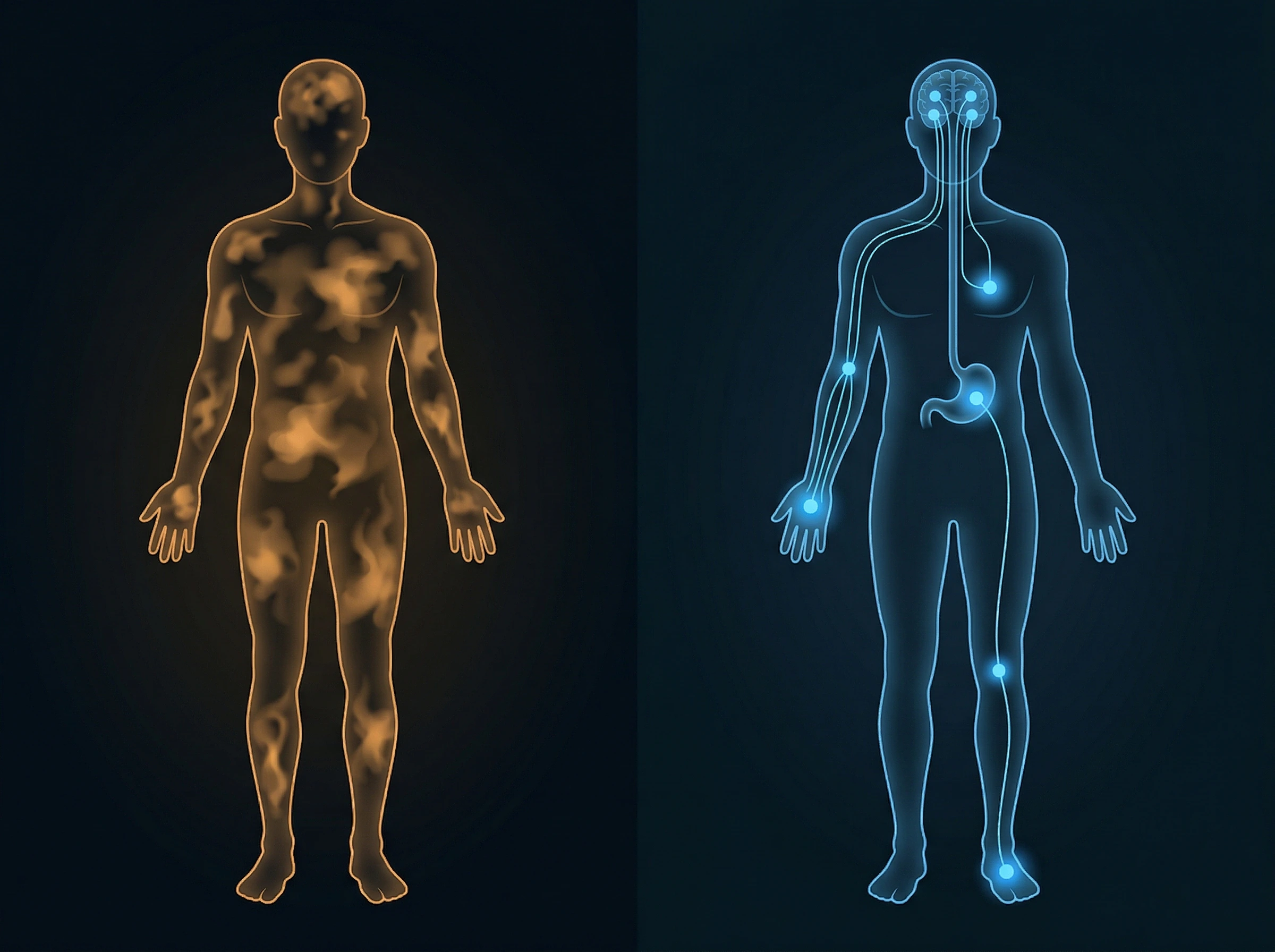
"Your somatic therapist helped you feel the fire alarm. This assessment finds the actual fire."
After the talk, I found her at the coffee station. I told her my story. Four years of talk therapy, two years of somatic work, almost $20,000, still stuck in the same patterns.
She wasn't surprised. "You're not unusual," she said. "You're actually the most common profile we see. Intelligent, self-aware, has done genuine therapeutic work. Talk therapy gave you the narrative. Somatic therapy gave you body awareness. But neither gave you the map."
"The map?"
"Your Childhood Pattern Map. The specific connections between your early experiences and your current automatic behaviors. Without it, therapy and somatic work are operating in the dark. They can help you manage what comes up. They can't show you why it keeps coming up."
She told me about Playa, an assessment platform her research colleagues had helped develop. Twelve minutes. Branching logic calibrated to your specific responses. Designed to bypass both conscious narrative and general body awareness to reach the actual encoding layer.
"Think of it this way," she said. "Your talk therapist helped you understand the fire alarm is ringing. Your somatic therapist helped you feel the fire alarm in your body. This assessment finds the actual fire."
I wrote down the name on a napkin. That night, lying in bed at midnight with my phone, I took the assessment.
I took the assessment expecting nothing. The results explained six years of being stuck.
I almost didn't finish it. After two years of somatic exercises and four years of therapy, I'd become skeptical of anything that promised answers. My nervous system was on high alert for wellness grifts.
But the questions were different from anything I'd encountered in therapy or somatic work. They didn't ask me to retell my story. They didn't ask me to notice sensations. They asked about dynamics I'd completely forgotten or never consciously registered.
How my parents responded when I showed excitement as a child. What happened in my household when someone was sick. Whether approval was something I received or something I performed for. The subtle architecture of my earliest emotional environment, not the dramatic events, the quiet everyday patterns I'd never thought to question.
Twelve minutes later, I had my Childhood Pattern Map.
I stared at the screen for a long time.
It identified four core patterns running my adult life and traced each one back to specific childhood dynamics I'd never connected to my current behavior.
The first one hit hardest. It explained why every relationship followed the same script: a childhood dynamic where love was earned through self-erasure. No talk therapist had named it that specifically. No somatic session had been able to target it. There it was on a screen at midnight.
The Sunday dread. It had a name now, and an origin I'd completely forgotten. A weekly childhood routine, a specific anticipatory anxiety pattern encoded before I was old enough to understand what anxiety even was. I'd been carrying a seven-year-old's dread into every Sunday of my adult life.
And then I understood why two years of somatic work had helped but never resolved anything. I'd been discharging activation without addressing the specific childhood encoding that kept regenerating it. Like bailing water without fixing the leak.
The fourth one blindsided me. I'd never connected my chronic over-commitment at work to anything from childhood. But there it was: a dynamic where being useful was the only reliable way to guarantee I wouldn't be forgotten.
Not general categories. Actual connections I could trace, with origins I could remember and behaviors I recognized immediately.
I sat on my bathroom floor at 12:30 AM and cried. Not from sadness. From relief. Six years of doing the right things, and nobody had ever shown me this. Not because my therapists were bad. Because the tools they had weren't built to see it.

Week 1: I stopped bailing water and started fixing the leak
I got a personalized program after the assessment. Daily exercises, five to ten minutes, based on developmental psychology frameworks. Not somatic regulation exercises. Not cognitive reframing. Something different: targeted pattern work tied directly to the childhood dynamics my map had identified.
Day 1, the program prompted me: "Notice when Pattern #1 activates today. Don't try to regulate it, breathe through it, or analyze it. Just notice it."
Pattern #1 was the self-erasure pattern, traced to a childhood where my emotional needs were consistently deprioritized. Every somatic therapist I'd seen had helped me feel the tightness that accompanied people-pleasing. None had connected it to that specific childhood dynamic.
That afternoon, I was about to agree to a project I didn't want. I felt the pattern activate. Not just the tightness in my chest, which I'd learned to notice in somatic work. The full sequence: the childhood encoding firing, the automatic "be useful or be forgotten" response, the body tightening in service of the pattern. For the first time, I could see the whole chain, not just the body's end of it.
Day 3 was harder. The program asked me to sit with a specific childhood memory, one the assessment had flagged, for three minutes. No analysis. No breathwork. No pendulation. Just presence.
I remembered being eight years old and my mother being sick for a week. I had made her toast every morning and cleaned the kitchen without being asked. Not because I wanted to help. Because somewhere in my eight-year-old brain, a calculation had been made: if I'm useful enough, she won't leave. I'd never told any therapist about that week. It seemed too small. Too ordinary. But the pattern map had identified it as a keystone experience, the moment that encoded "being needed" as the price of love.
By Day 5, I wanted to quit. The exercises felt too simple after years of intensive somatic work. Sit with a memory for three minutes? I was used to full-body tremoring sessions and two-hour breathwork intensives. This felt like a step backward.
But I kept going. And by Day 7, something happened that no amount of regulation work had achieved in two years. I said no to a weekend commitment, and the guilt just... didn't fire. Not softened. Gone. As if seeing the pattern's actual origin had disconnected it from the automatic response.
My somatic therapist would have called that "nervous system regulation." But it wasn't. It was something deeper. The pattern itself had loosened. Not the body's response to the pattern, the pattern.
Week 3: both my therapists asked what changed
By week three, the changes were happening automatically. Without breathwork. Without conscious regulation. Without catching myself and choosing a different response.
My partner cooked dinner on a Wednesday. I sat on the couch and didn't check my phone once. In two years of dating, that had never happened. He noticed: "You're different lately. Present. Not somewhere else."
Then my talk therapist, during our monthly session: "Something shifted. You're not narrating your experience anymore. You're in it. What happened?"
Then my somatic therapist: "Your nervous system is responding differently. Less guarding. What changed between sessions?"
I told them both about Playa. My talk therapist asked for the name. My somatic therapist said, "That makes sense. We've been working with the body's response. Sounds like this works with what's generating the response."
That framing stuck with me. For two years, somatic therapy had been helping me manage the body's response to patterns I'd never actually identified. Now that the patterns were mapped, the body was settling on its own. Without me having to regulate it.
The changes kept compounding:
- The Sunday dread disappeared by Week 2. Completely. After six years.
- I stopped over-explaining myself in emails. Just stopped. Pattern #4 no longer running.
- I slept through the night without the 3 AM wake-up for the first time since my twenties.
- My partner said I laughed differently. "Louder. Less careful."
- I got the best performance review of my career. My manager said my work had "more clarity and less second-guessing."
All from five to ten minutes a day with an assessment that found what six years of therapy and somatic work had missed.

Why somatic therapy patients plateau: they're regulating responses without mapping the source patterns
Here's what the researcher told me that I think about every single day.
Somatic therapy is excellent at nervous system regulation. It helps you notice activation, discharge survival energy, develop body awareness. But most of what drives our behavior got wired in before we could talk, before we had any body awareness at all. She said the research suggests something like 80% of our behavioral patterns run beneath both conscious thought and body sensation. Those neural pathways just run. Somatic work can't always reach them because they were laid down before the body even had the vocabulary to describe what was happening.
You can't shake your way to patterns you can't see.
This isn't a criticism of somatic work. It's a limitation of the approach. Somatic therapy works with the body's response to encoded patterns. Childhood Pattern Mapping works with the encoding itself. They're different layers.
That's why 89% of people who take the assessment identify specific childhood influences within 12 minutes that they'd never uncovered before, even after extensive body-based work. Not because somatic therapy failed. Because it was designed to do something different.
The CDC-Kaiser ACE study, one of the largest public health studies ever conducted with over 17,000 participants, found that two thirds of adults report at least one adverse childhood experience. Those with four or more ACEs were 12 times more likely to attempt suicide and showed dramatically increased rates of chronic disease, mental illness, and substance use (Felitti et al., 1998).
These experiences don't just live in your body. They live in your neural wiring. Somatic therapy addresses the body. Pattern mapping addresses the wiring.
Beyond the tremoring: what actually changes when you find the source
I started this expecting to understand my patterns better. I got that. But the real changes were things I didn't expect.
My first genuinely secure relationship. Not because I found a better partner, because I stopped unconsciously selecting partners who confirmed my childhood belief that love requires self-erasure.
Rest that doesn't require a regulation exercise first. Not the kind where I lie on a mat and pendulate between activation and calm. Actual rest. Where I sit on the couch and my nervous system stays quiet without being told to.
The background noise stopped. That low-frequency hum of "something is wrong with me" that I'd carried since childhood and that somatic therapy had taught me to notice but never resolved? Gone. Not because I learned to regulate around it. Because I understood where it came from, and it lost its power.
I still do somatic work occasionally. I still value it. But I no longer need it to function. The patterns that kept regenerating the activation have been mapped and addressed. My nervous system is settling because the source code changed, not because I'm constantly regulating the output.
This 2-minute quiz reveals your specific childhood pattern type (and why body work alone hasn't been enough)
I wonder sometimes how different things would have been if I'd found this three years ago. Before the second therapist. Before the somatic practitioner. Before the breathwork retreats and the polyvagal playlists and the $20,000 I spent circling patterns I couldn't see.
I wasn't failing at therapy. I wasn't failing at somatic work. Both were doing exactly what they were designed to do. They just weren't designed to do this.
A friend asked me recently where to start. I told her what the researcher told me: before the full assessment, take the short quiz first. Two minutes. It asks a few questions about how you experience relationships, stress, and physical tension. Then it identifies your primary pattern type and why the approaches you've tried so far have been incomplete.
After that, you get access to the full 12-minute assessment with your personalized report, the one built for how your specific brain was wired in childhood.
The program takes five minutes a day. They told me that of the 127,000-plus people who've done this, 96% reached a level of self-understanding they'd never hit before. Within 30 days.
Right now, new users get 60% off personalized programs. That's less than what most people pay for a single therapy session or somatic appointment.
You don't need to commit to anything. You don't need to retell your story or lie on a mat and shake.
You just need to see what's actually been running the show.

Results may vary due to personal features. Health Post does not provide medical advice, diagnosis, or treatment.
Comments (0)