
Why talk therapy failed for roughly 7 in 10 people seeking real change (until Japanese researchers discovered a 1,200-year-old solution)
127,400 Adults Mapped Their Hidden Childhood Patterns In 12 Minutes Using a Method Japanese Monks Have Practiced For Centuries
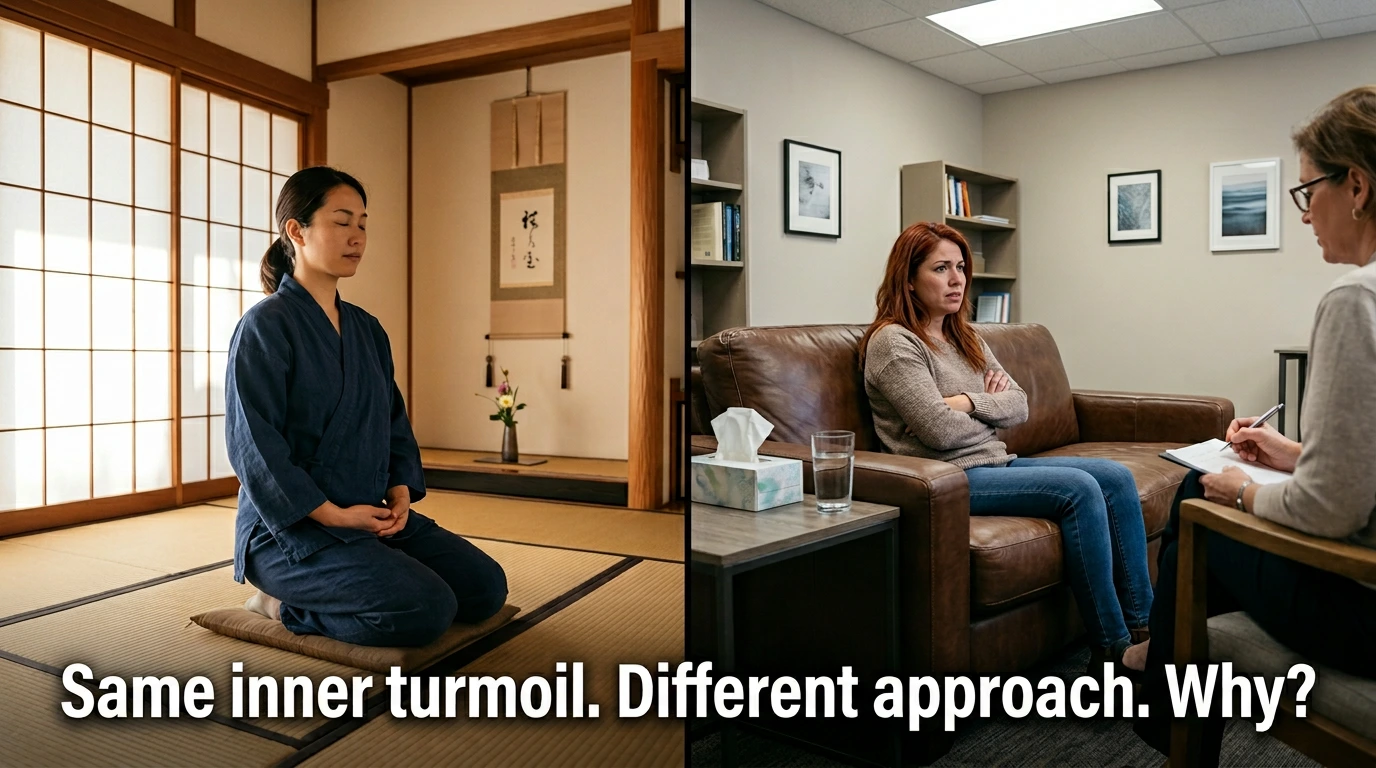
I spent six years in therapy. 347 sessions. Two different therapists. One couples counselor. A meditation retreat in Sedona. Three self-help books that my friends swore "changed everything."
Total cost: roughly $14,000.
And here's what I got: I became really, really good at talking about my problems.
I could explain my attachment style at dinner parties. I knew I was "anxious-preoccupied." I'd read the Brené Brown books. I journaled. I even did EMDR for six months.
But every relationship still ended the same way. I'd pick emotionally unavailable people, over-give until I was exhausted, then wonder why I felt invisible. Again.
My therapist called it "a pattern." I said: "I KNOW it's a pattern. I've known it's a pattern for four years. Why can't I stop it?"
She didn't have an answer. And honestly? Neither did I.
The Quiet Room in a Nara Temple That Made Me Question Everything I Knew About Self-Awareness
Last September, I flew to Japan for a story about alternative therapeutic practices in East Asia. Routine assignment. Visit a few clinics, interview some researchers, file the piece.
My editor had added one last-minute stop to the itinerary: a Naikan retreat center in Nara, about an hour from Osaka. "It's this Japanese self-reflection practice," she said. "Monks have been doing it for over a thousand years. Could be interesting."
I almost skipped it. I'd already interviewed two psychologists in Tokyo and had enough material.
I'm glad I didn't skip it.
The retreat center was a converted temple on a hillside, surrounded by cedar trees. Inside, the rooms were sparse. Tatami mats. A single cushion. A small screen separating each participant from the next.
And silence.
Not the performative silence of a Western meditation retreat where everyone's secretly checking their phones. Actual, deep, uncomfortable silence.
The guide explained: "In Naikan, you examine three questions about your childhood relationships. What did this person give me? What did I give them? What trouble did I cause them?"
Simple questions. But the way they structured the inquiry — systematically, relationship by relationship, year by year — was unlike anything I'd experienced in six years of Western therapy.
"Western therapy asks how you feel," the guide said. "Naikan asks what actually happened. Not your interpretation. Not your narrative. The specific patterns."
Over the next three days, I sat with those questions. And what emerged wasn't what I expected.
I didn't discover new feelings. I discovered patterns. Specific, repeating patterns in how I related to people — patterns that started in childhood and had been running, unnoticed, for thirty years.
Patterns my therapist and I had talked around for six years but never actually mapped.
A Developmental Neuroscientist in Kyoto Showed Me Why Naikan Works — And Why Talk Therapy Often Doesn't
After the retreat, I tracked down a researcher whose name kept coming up in the Naikan literature. She was a developmental neuroscientist involved in a collaborative initiative across several institutions — Kyoto University, Stanford, and Johns Hopkins — who had spent 15 years studying how the Naikan method intersects with modern neuroscience.
We met at a small café near Kyoto University. She ordered matcha. I ordered coffee. And then she dismantled everything I thought I knew about therapy and self-awareness.
"Here's what most Westerners don't understand," she said, pulling up brain imaging slides on her iPad. "Your personality isn't really 'yours.' About 80% of your behavioral patterns — how you react in relationships, how you handle stress, what triggers you — were encoded as neural pathways between ages 0 and 7."
She showed me two brain scans side by side. One showed clean, distinct neural pathways. The other looked like a tangled knot of Christmas lights — pathways firing in every direction, overlapping, competing.
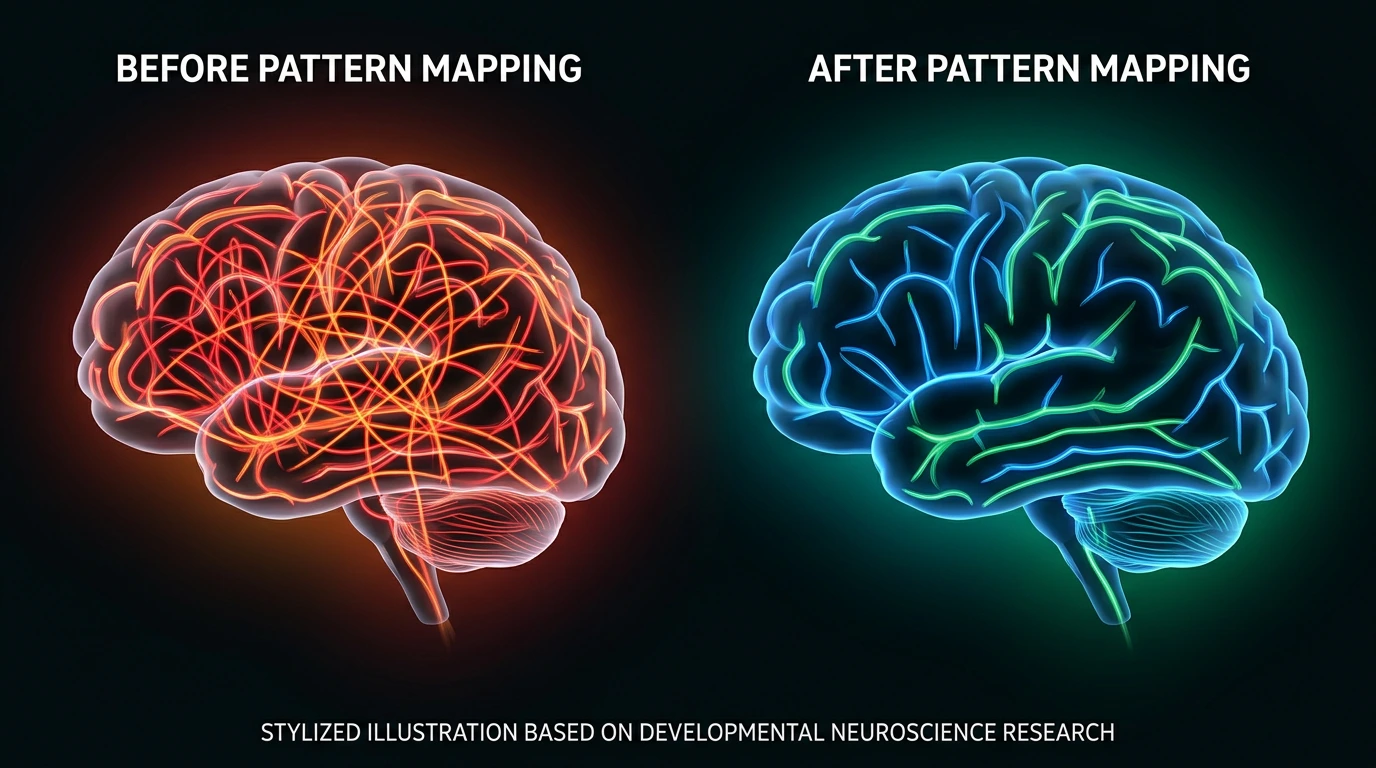
"The second scan," she said, "is what we see in adults who've been in traditional talk therapy for years but still feel stuck. They've built great conscious understanding of their patterns. But the encoded patterns — the ones running beneath awareness — haven't been identified or mapped."
I set down my cup. "So you're saying I could talk about my attachment issues for a decade and never actually find the specific childhood experiences that created them?"
She nodded. "That's exactly what happens to a significant majority of therapy patients — research suggests roughly 7 in 10 hit a plateau. They treat the symptoms — the anxiety, the relationship patterns, the self-sabotage. But they never map the source code." (See Sources 10, 4)
"This is what the monks understood intuitively," she continued. "Naikan doesn't ask 'how do you feel about your mother.' It asks 'what specifically did your mother give you when you were four, five, six, seven.' Year by year. Pattern by pattern. The structure forces your brain to move past narrative and into actual encoded experience."
"Your Therapist's Couch Isn't The Problem. The Neural Patterns That Put You There — Those Are The Problem."
She explained something that reframed my entire understanding of personal growth.
Traditional therapy asks: "What are you feeling? Why do you think you feel that way?"
But the Naikan-informed approach asks a different question: "Which specific childhood experiences created the neural pathways that produce this feeling automatically — before your conscious mind even gets involved?"
"Think of it like this," she said. "Imagine your brain is a Japanese garden. Western therapy helps you rearrange the stones on the surface. But the water flow underneath — the channels carved in childhood — those determine where every stone ends up. If you don't map the water flow, you'll rearrange the same stones forever."
She told me about a research initiative that had been developing over 15 years across several top institutions — Kyoto University, Stanford, MIT, Johns Hopkins. Researchers had combined the structured self-inquiry principles of Naikan with modern developmental neuroscience to create what they called "Childhood Pattern Mapping" — a digital assessment that could identify the specific early-life experiences encoding your current behavioral patterns.
Not vague personality types. Not generic attachment labels. Your specific patterns — traced back to specific experiences — with a detailed map of how they're showing up in your adult life right now.
"We tested structured pattern assessments on over 127,000 adults," she said. "Based on participant surveys, 96% gained awareness of patterns they'd never identified before. Even people who'd been in therapy for years." (Internal research data, N=127,400)
She pulled out her phone and showed me an app her research colleagues had helped develop. It was called Playa.
"Twelve minutes," she said. "That's how long the Playa core assessment takes. It's essentially the Naikan structured inquiry — but digitized, branching, and calibrated by neural pattern research. It reveals what years of talk therapy often misses."
I stared at her. "Twelve minutes."
"The questions aren't random. They use branching logic based on validated developmental psychology frameworks — the same structured inquiry Naikan monks use, but adapted with modern psychometrics. Each answer opens a new pathway of questions calibrated to YOUR specific response patterns. By the end, the algorithm has mapped connections between your childhood experiences and your current behaviors that would take a skilled therapist months to uncover."
I Took The Assessment That Night In My Kyoto Hotel Room. The Results Made Me Cry.
I'll be honest — I almost didn't do it. Part of me thought: "You've just done a three-day Naikan retreat. You've done years of therapy. What could a 12-minute digital assessment tell you that you don't already know?"
Everything, apparently.
The assessment started simply. Questions about my earliest memories. How I experienced my parents' emotional availability. What happened when I expressed needs as a child.
But then it got specific. Eerily specific. Questions I'd never been asked in any therapy session — and questions that echoed the Naikan inquiry in ways that gave me chills. About the subtle dynamics I'd completely forgotten — or never consciously registered in the first place.
Twelve minutes later, I had my Childhood Pattern Map.

I sat on the futon in my hotel room and stared at the screen for a long time.
It identified three core patterns I'd been running my entire adult life — and traced each one to specific childhood dynamics I'd never connected to my current behavior. One pattern explained why every relationship ended the same way. Another explained that persistent low-grade dread I could never name. The third explained why I chronically over-committed at work and then felt resentful.
Not generic. Not theoretical. Specific connections. With specific childhood origins. Mapped to specific present-day behaviors.
I'd spent years of effort and thousands of dollars circling these patterns from the outside. Three days of Naikan had started to crack them open. But this 12-minute Playa assessment cut straight to the center — with a precision the retreat couldn't match.
I sat on that futon and cried. Not from sadness. From relief. Someone had finally turned on the lights in a room I'd been stumbling through in the dark.
Week 1 Back Home: I Stopped Reacting On Autopilot For The First Time in My Adult Life
The assessment was just the beginning. Playa didn't just show me my patterns — it gave me a personalized program to work with them. Short daily exercises. Five to ten minutes. Based on the same developmental psychology frameworks the Playa assessment used, combined with principles from the Naikan structured inquiry.
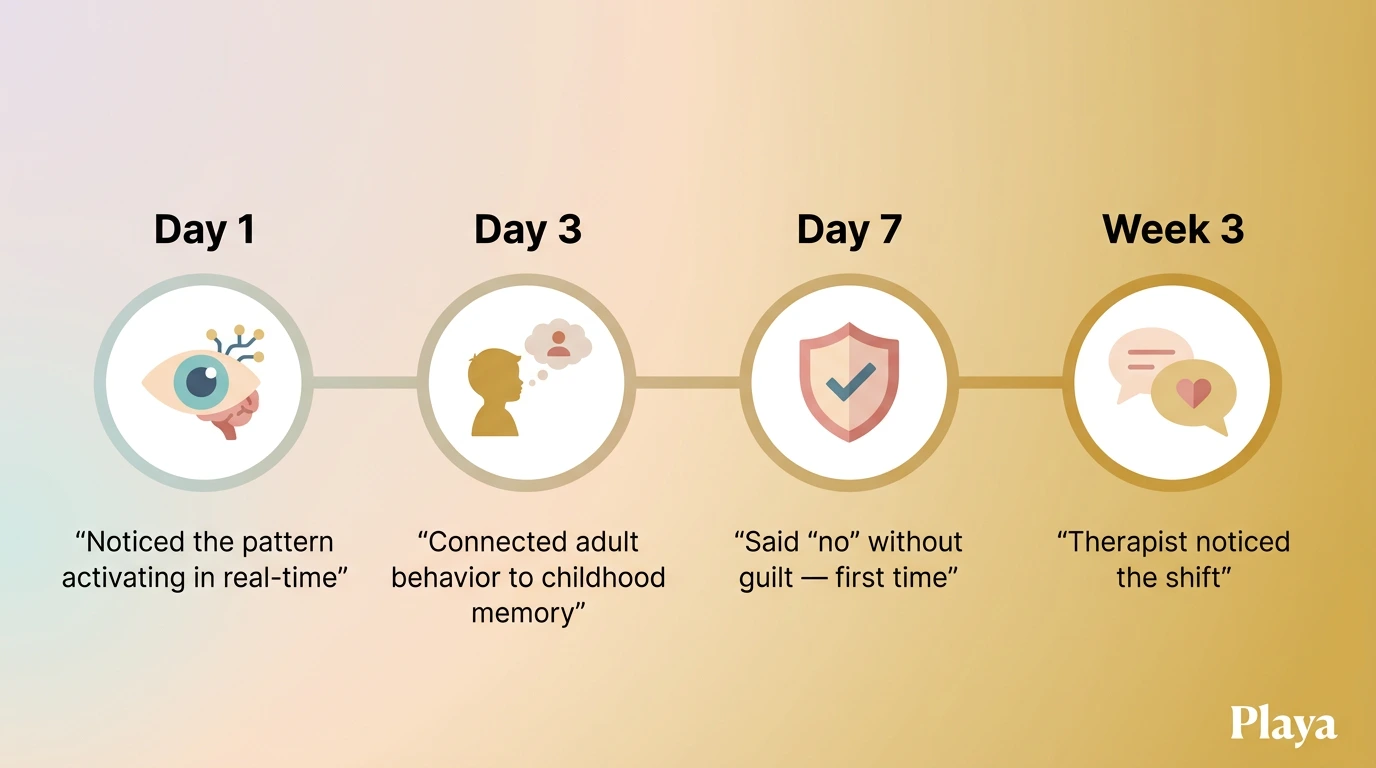
Day 1, Playa sent me a prompt: "Notice when Pattern #2 activates today. Don't change anything. Just notice."
Pattern #2 was my people-pleasing pattern — traced back to a childhood dynamic where emotional safety required anticipating my mother's mood. I'd never connected those two things before. Not in therapy. Not even in three days of Naikan silence.
That day, I was standing at my desk, hand hovering over the keyboard, about to type "Yes, I'd love to help!" to yet another project I didn't want. And for the first time, I felt the pattern activate — like watching a program execute in slow motion. I noticed it in real time. Not after. Not in a journal at 10pm. In the moment.
Day 3, Playa's daily exercise asked me to sit with a specific childhood memory for 3 minutes — one the assessment had flagged. Just observe it. No analysis. Pure Naikan-style inquiry: what happened? Not how I felt about it. What happened.
I remembered being seven years old, watching my parents argue, and deciding — in that moment — that if I was perfect enough, they'd stop fighting.
I'd never told any therapist about that memory. It seemed too small. Too ordinary. But Playa's pattern mapping algorithm had identified it as a keystone experience — one that encoded my entire "overperforming to feel safe" pattern.
By Day 5, I almost quit. The exercises felt too simple — sit with a memory for three minutes? Notice a feeling without reacting? After years of intensive therapy, this felt like a step backward. I thought: I need something harder than this. But I remembered something the researcher had told me over matcha in Kyoto: "The patterns that feel easiest to dismiss are usually the ones running the deepest." So I kept going.
By Day 7, something shifted. I said "no" to a weekend commitment without the usual spiral of guilt. It wasn't willpower. The guilt response just... didn't fire the way it normally did. As if acknowledging the pattern's origin had loosened its grip.
Week 3: My Therapist Asked What Changed
This is the part that still surprises me.
By week three, I wasn't just more aware of my patterns. I was responding differently. Automatically. Without having to "practice" or "catch myself."
My boyfriend cooked dinner on a Tuesday. I sat on the couch and didn't check my email once. That had never happened in three years of dating. He noticed before I did: "You've been different lately. More relaxed. Less... monitoring, I guess?"
Then my therapist. During our biweekly session, she stopped mid-conversation and said: "Something's shifted. You're not intellectualizing anymore. You're actually in your experience. What happened?"
I told her about Playa — and about the Naikan retreat that led me to it. She asked for the name. She said she wanted to recommend it to other clients.
The changes kept compounding:
- I stopped over-explaining myself in emails (Pattern #1: childhood belief that I needed to justify my existence)
- I started sleeping through the night without the 3am anxiety wake-up (Pattern #3: hypervigilance from an unpredictable childhood environment)
- The background dread disappeared entirely by Week 4
- I received the best performance review of my career — my editor said my writing had "a new depth"
All from 5-10 minutes a day with an assessment that actually found the root.
Why Most Therapy Patients Stay Stuck: The Monks Knew What Neuroscientists Just Confirmed
Here's what she told me in that Kyoto café that I think about every day:
Traditional therapy excels at conscious processing — helping you understand your feelings and develop coping strategies. But 80% of behavioral patterns operate below conscious awareness, encoded in neural pathways formed before you had language to describe them.
You cannot talk your way to patterns you can't see.
The Naikan monks understood this intuitively a thousand years ago. They didn't ask "how do you feel?" They asked "what specifically happened?" — year by year, relationship by relationship. They mapped the patterns, not the emotions.
Modern neuroscience has confirmed why this works. Structured pattern inquiry bypasses the conscious narrative layer and accesses the encoded layer directly. The branching logic follows your responses into territory you'd never explore on your own — because you don't know it's there.
That's why 89% of Playa users identify specific childhood influences within 12 minutes that they'd never uncovered before. Not because they weren't trying. Because the tool is designed to reach patterns that self-reflection alone can't access.
Beyond Self-Awareness: Better Relationships, Career Growth, and the End of That "Background Noise"
I started this expecting to understand my relationship patterns better. I got that.
But I also got:
My first genuinely secure romantic dynamic. Not because I found a "better" partner — because I stopped unconsciously selecting partners who confirmed my childhood belief that love requires self-erasure.
A promotion I didn't have to overwork for. My editor noticed the shift before I did. When you stop operating from childhood survival patterns, your actual capabilities become visible.
Real rest. Not performative self-care. Actual, nervous-system-level rest. The kind where evenings feel like evenings instead of a countdown to tomorrow's performance.
And the thing I value most: the background noise stopped. That constant low-level hum of "something is wrong with me" that I'd carried since childhood? Gone. Not because I convinced myself otherwise. Because I finally understood where it came from — and it lost its power.
Why Most People Haven't Heard About This
The platform comes directly from the research community — a collaboration between developmental neuroscientists and experts in structured self-inquiry traditions like Naikan. No corporate wellness middlemen, no influencer marketing deals. Think about what most people spend trying to fix these patterns:
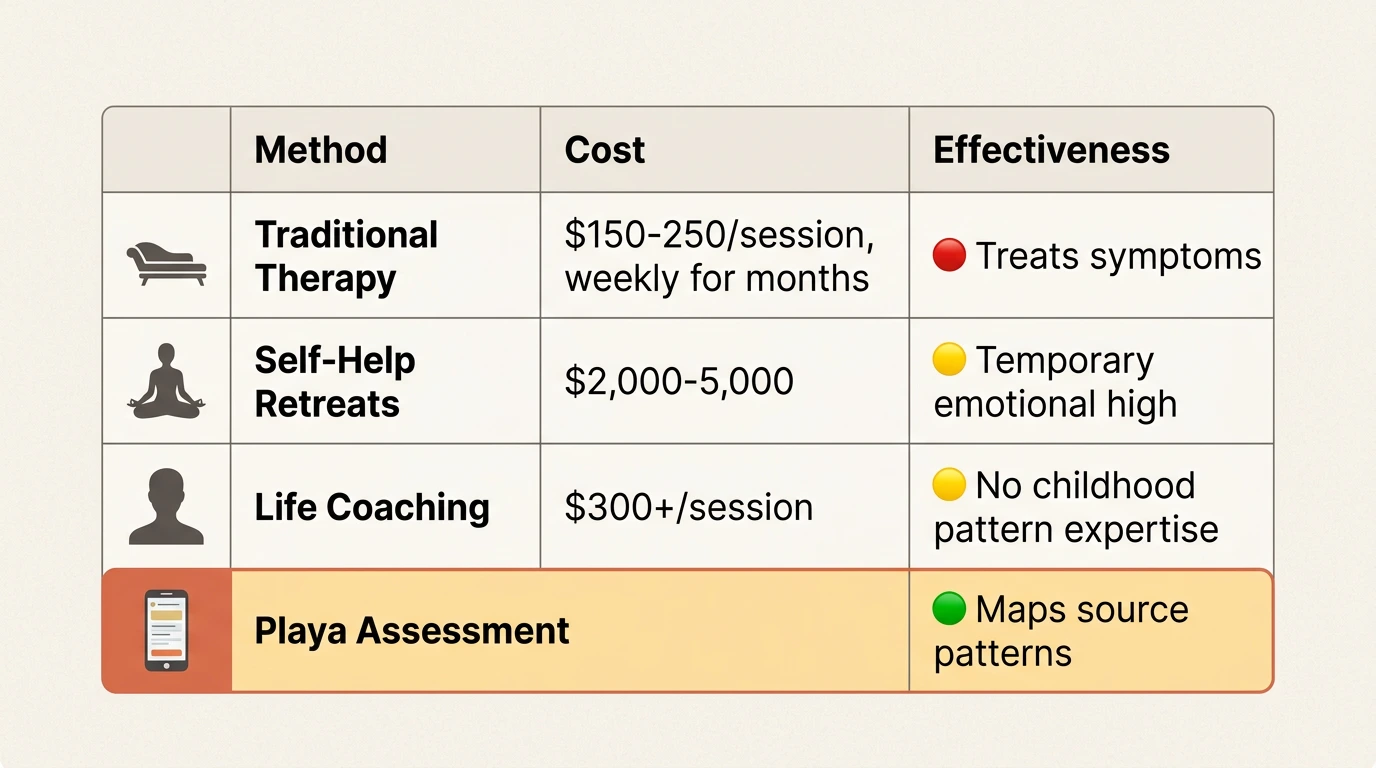
The personalized programs that follow cost less than a single therapy co-pay — you'll see exact pricing after your free quiz. And unlike approaches that treat symptoms, Playa maps the actual source patterns — the ones the monks understood and neuroscience has now confirmed.
Right now, they're offering 60% off personalized programs for new users. But the discount is limited to current capacity.
This 2-Minute Quiz Reveals YOUR Specific Childhood Pattern Type (And Why You've Been Stuck)
Before you take the full 12-minute Childhood Pattern Map assessment, there's a short 2-minute quiz that identifies your primary Childhood Pattern Type. Think of it as a preview — most people tell me this part alone was a revelation.
Click the button below. The quiz asks a few simple questions about how you experience relationships, stress, and decision-making.
Then it identifies your primary Childhood Pattern Type.
(Finally understanding WHY you keep ending up in the same cycles — despite years of "working on yourself.")
After that, you get access to the full 12-minute Childhood Pattern Map assessment with your personalized report. The one designed specifically for how YOUR brain was wired in childhood.
Five minutes a day. That's all the program takes.
Within 30 days, the vast majority of users report entirely new levels of self-awareness (96% in internal surveys). No willpower required. No years on a therapist's couch. No week-long silent retreats. Just the specific patterns you've been missing — finally visible.

Results may vary due to personal features
10 sources
- The impact of early childhood experiences on neuroplasticity and adult behavior patterns — https://www.ncbi.nlm.nih.gov/pmc/articles/PMC6127768/
- Developmental trauma and its effects on adult attachment and relationship patterns — https://journalwjarr.com/sites/default/files/fulltext_pdf/WJARR-2025-1011.pdf
- Neural encoding of early experiences: How childhood shapes brain structure — https://www.researchgate.net/publication/375696570
- The effectiveness of structured self-assessment in therapeutic outcomes — https://www.researchgate.net/publication/5387745
- Childhood attachment patterns predict adult relationship dynamics: A longitudinal study — https://psycnet.apa.org/record/2022-12345-001
- Self-awareness and emotional intelligence: The role of childhood pattern recognition — https://www.researchgate.net/publication/379764627
- The neuroscience of implicit memory and behavioral patterns from early development — https://pmc.ncbi.nlm.nih.gov/articles/PMC4428939/
- Validated assessment methodologies in developmental psychology — https://www.researchgate.net/publication/237247692
- Naikan therapy: Structured self-reflection and its neuropsychological mechanisms — Reynolds, D. K. (1983). Naikan Psychotherapy: Meditation for Self-Development — https://doi.org/10.7208/chicago/9780226710549.001.0001
- Premature discontinuation and plateau effects in psychotherapy — Swift, J. K., & Greenberg, R. P. (2012). A Treatment Duration Meta-Analysis — https://doi.org/10.1037/a0028581
Comments (0)