
The Quiet Politics of Gamers: Why Players Lean More Inclusive Than the Public
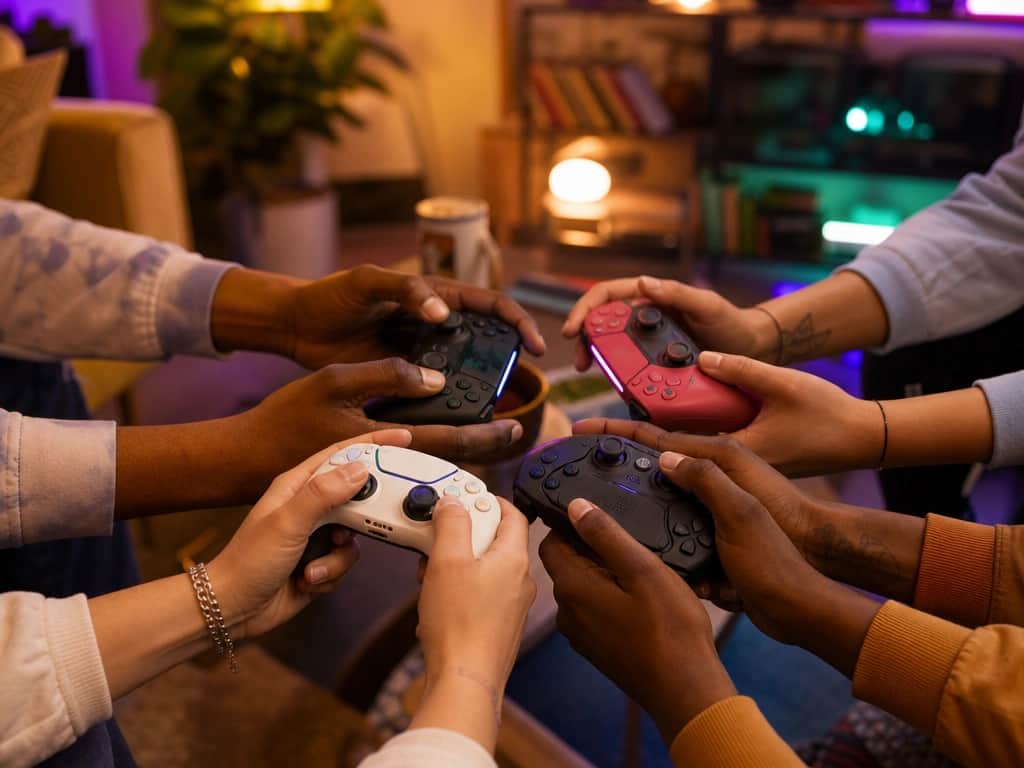
Picture the stereotype of a gamer, the one that hardened during the GamerGate harassment campaign a decade ago. Probably a young man, probably angry, probably hostile to anyone who looked or thought differently. It became a shorthand for a corner of the internet that seemed to curdle into resentment. So here is a question worth sitting with: what if that picture was never an accurate portrait of the people actually holding the controllers?
A new study suggests it was not. Drawing on survey responses from more than 77,000 Americans, researchers found that people who play video games tend to hold more inclusive cultural values than the public at large [1]. They were less attached to traditional gender roles, more supportive of social tolerance, and in several measures more committed to equality. The loud minority that dominated the headlines, it turns out, may have told us very little about the median player.
The work comes from Sean Pauley, Wil Dubree, and Brule E. Woods, doctoral researchers at the School of Journalism and Mass Communication at the University of Wisconsin-Madison. Their paper, "Prepare to DEI: Addressing GamerGate Through Political Opinions and Cultural Values in Gaming Communities," appears in the American Psychological Association journal Psychology of Popular Media [1]. The framing is deliberate. GamerGate cast a long shadow over how gaming culture is discussed, and the authors set out to test whether the politics of that moment reflected the politics of players.
What the numbers actually showed
The dataset is the unusual strength here. Rather than recruiting volunteers online, where the loudest voices tend to oversample themselves, the team used MRI-Simmons market research data built on address-based probability sampling. That matters because it reaches a representative slice of the country rather than the people who happen to click on a survey link. The researchers pooled responses from 2012, 2016, and 2020, which lets them watch attitudes across nearly a decade of cultural churn.
To compare gamers against everyone else, they ran proportional odds logistic regression on a set of three-point attitude scales covering gender roles, social tolerance, and equality. They controlled for the obvious confounders too: age, income, education, gender, and survey year. That last set of controls is important. Gamers skew younger, and younger people tend to hold more progressive social views, so without adjustment you might mistake a generational effect for a gaming effect. After accounting for all of that, the gap held. Players still came out more inclusive than non-players.
The pattern even survived a stricter test. The team looked specifically at people who play shooter games and people who use Xbox Live, two groups often treated as the rowdy heart of the stereotype. Shooter players still leaned inclusive. Xbox Live users did as well, with one nuance: their views on equality landed roughly at the population average rather than above it. Notably, the researchers found no evidence anywhere in the data that gaming tracked with more exclusionary beliefs. Whatever GamerGate was, it was not the value system of the average gamer.
Why the gap might exist
The study describes the association rather than proving what causes it, but a few explanations are plausible. Gaming is intensely social now, and online play throws people together with strangers from different backgrounds, ages, and countries. Contact like that has long been linked in social psychology to softer attitudes toward out-groups. It is also possible the causal arrow runs the other way, with more open-minded people simply being drawn to a hobby built on collaboration and shared worlds. The data here cannot settle that question, and the authors are careful not to overclaim.
The caveats worth keeping
A few limits deserve attention before anyone treats this as the final word. The survey was repeated across years but did not follow the same individuals over time, so it captures snapshots of different people rather than tracking how any one person's views shift. That rules out strong causal claims. The self-reported attitude measures are also coarse, just three points on a scale, which can flatten real differences in how strongly someone holds a belief.
Then there is the problem of categories. Lumping every shooter into one bucket erases enormous variation between, say, a cooperative tactical game and a toxic ranked lobby. Community dynamics differ wildly within a genre, and a single label cannot capture that. The findings also describe American players specifically, so it would be a stretch to assume the same holds in every gaming culture worldwide.
Still, the headline is hard to ignore. A representative sample of tens of thousands of people points in one direction, and it is not the direction the stereotype predicted. The angriest voices in a community are rarely a fair sample of it. That is true of gaming, and it is probably true of most groups we think we understand from their worst moments online. The people quietly playing, it seems, were a different crowd all along. The gap between loudest voices and the actual distribution of attitudes turns up in political research too: how racial resentment mobilizes some voters while suppressing others shows how the same attitude can produce opposite behaviors depending on the social identities a person carries. For more on the psychology of group attitudes and behavior, browse more psychology coverage.
Sources
- Pauley, S., Dubree, W., & Woods, B. E. (2026). Prepare to DEI: Addressing GamerGate Through Political Opinions and Cultural Values in Gaming Communities. Psychology of Popular Media. https://doi.org/10.1037/ppm0000672
This article summarizes published research for general informational purposes only and does not constitute professional advice.
Frequently asked questions
- How did researchers ensure the gamer sample was representative?
- The team used MRI-Simmons address-based probability sampling across 77,000 Americans rather than recruiting volunteers online, where louder voices tend to oversample themselves. They controlled for age, income, education, gender, and survey year to separate a gaming effect from a generational one.
- Did the study find any subgroup of gamers with more exclusionary attitudes?
- No. Even shooter-game players and Xbox Live users leaned inclusive compared to non-players, though Xbox Live users' views on equality were closer to the population average rather than above it. The researchers found no evidence anywhere in the data that gaming was associated with more exclusionary beliefs.
- Does this study prove that gaming causes more inclusive attitudes?
- No. The study describes an association, not a cause. The survey captured snapshots of different people across three election years rather than tracking the same individuals over time, so it cannot establish whether gaming shifts attitudes or whether more open-minded people are simply drawn to gaming.
Comments (7)
Priya
Spent three years moderating a large Discord for a tactical shooter. The loudest 5% generated nearly everything in the ban queue. Everyone else was just quietly helping each other with callouts, swapping builds, talking through tilt. You could go weeks without encountering anything hostile if you weren't digging through the report log. The community that exists when bad actors aren't actively performing is genuinely different from the one outsiders imagine.
David
Comparing gamers favorably to a general public that's still deeply divided on gender roles is not a demanding benchmark. I want this to be real — the probability sampling is more rigorous than most attitude research — but I'd feel a lot more confident if the paper reported the actual scale means rather than just the directional gap.
Sam
Quiet cooperation. That's most of it.