
When Racial Resentment Pushes Some Voters to the Polls and Others Away
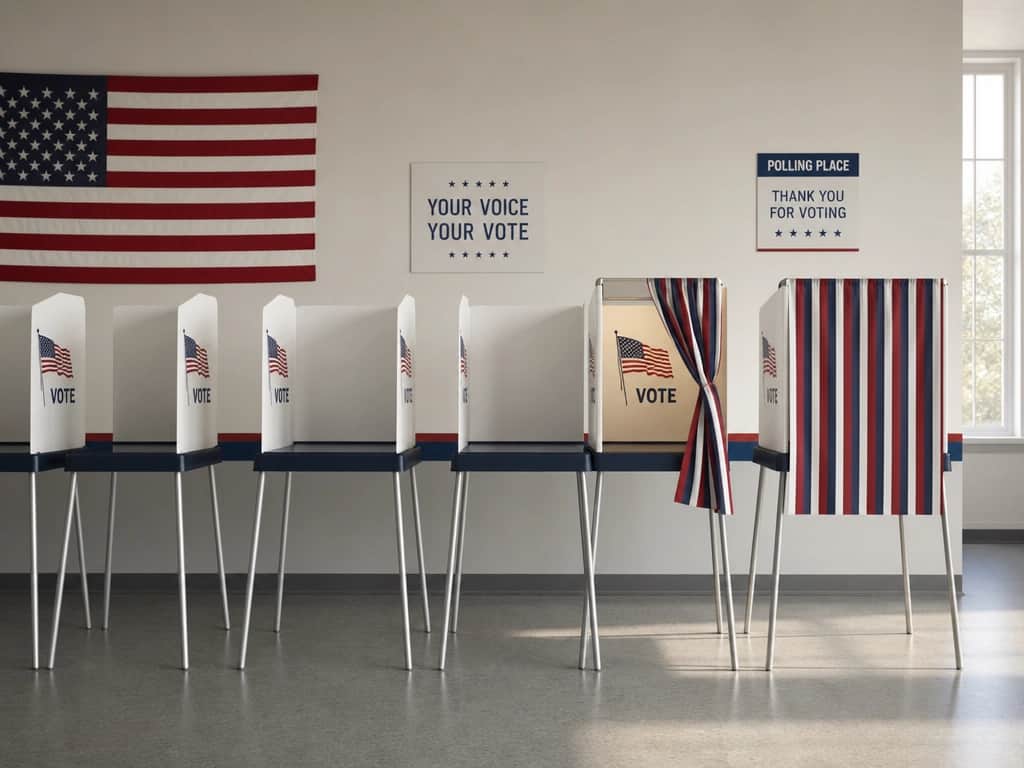
We tend to talk about a person's attitudes as if they point in one direction. Hold a certain view, the thinking goes, and it nudges your behavior a predictable way. But what happens when a belief sits awkwardly against the rest of who you are? A new analysis of American voters suggests the answer is not tidy at all. The same racial attitude that sends one person to the ballot box keeps another at home.
The study comes from Nathan K. Chan, a political scientist at Loyola Marymount University, and appears in the Journal of Race, Ethnicity, and Politics, published by Cambridge University Press [1]. Chan set out to understand a question that sounds simple and turns out not to be: does racial resentment change whether people vote, and is the effect the same for everyone who holds it?
His data came from the 2020 Collaborative Multiracial Post-Election Survey, a large post-election study notable for oversampling groups that national polls usually thin out. It ran in English, Spanish, Mandarin, Cantonese, Korean, and Vietnamese, which let Chan look closely at Asian American and Latino respondents rather than folding them into a vague "other" category. Racial resentment was measured with a standard four-item scale, and turnout was not left to self-report alone. Where possible, respondents' claims about voting were checked against state voter records, which trims some of the inflation that creeps in when people are asked whether they did their civic duty.
The headline pattern is striking. Among white evangelicals, higher racial resentment lined up with higher turnout, by something on the order of twenty percentage points [1]. The same upward push appeared among Asian American and Latino evangelicals. For those groups, a more resentful racial outlook seemed to function as fuel, a reason to show up.
Then there is the reversal. Among Black evangelicals, the relationship flipped. Those scoring highest on racial resentment were markedly less likely to vote, by roughly twenty-three points. The attitude that mobilized other evangelicals appeared to do the opposite for them.
Why would one belief work in two directions? Chan leans on what political scientists call conflict decision theory. The idea is that when a person's identities and pressures pull toward different choices, the friction itself can be disabling. A Black evangelical who holds conservative racial views is caught between commitments that do not sit comfortably together: a religious and racial community with its own political center of gravity, and a personal attitude that points elsewhere. Faced with that internal tug-of-war, some people resolve it not by picking a side but by stepping back from the decision entirely. Staying home becomes the path of least conflict.
What sharpens the finding is the comparison group. Among non-evangelicals across all the racial groups studied, racial resentment showed no clear link to turnout in either direction. So this is not a story about race alone, and it is not a story about religion alone. It is what happens when the two stack on top of each other. Evangelical identity seems to be the ingredient that turns a racial attitude into a force that either drives participation or quietly suppresses it.
It is worth sitting with how much that complicates the usual narrative. Commentators often treat racial resentment as a single lever that reliably boosts conservative turnout. Chan's results say the lever's direction depends on who is holding it and what else they carry. Identity is not additive in a simple way. Two people can share an attitude and a faith and still be moved in opposite directions because the rest of their social world differs.
A few cautions are in order. This is a single cross-sectional survey tied to one election, the 2020 presidential contest, which was unusual in turnout and intensity. Correlation is not cause here; the design cannot prove that resentment drives the turnout gap rather than tracking some other difference between these groups. Subdividing evangelicals by race produces smaller cells, which widens the uncertainty around any one estimate, and the "racial resentment" scale itself is a contested measure that some researchers argue captures more than racial animus. Whether the same pattern would hold in a lower-stakes midterm, or a decade from now, is an open question. Replication with other datasets and other elections would do a lot to firm up the picture.
Still, the core observation is hard to wave away. An attitude does not act on its own. It acts through a person, and a person is a bundle of memberships that can reinforce or contradict each other. Ask not only what someone believes, but what believing it costs them given everything else they are. The answer may explain who turns up and who stays away. That insight — that the same underlying attitude can produce opposite behaviors depending on which identities are in play — resonates with findings on whether gamers actually hold the exclusionary attitudes GamerGate implied, where the loudest segment of a community turned out to be a poor guide to the median member. It also echoes work on how personality and attachment predict forgiveness of infidelity, where the same trait pointed in different directions depending on the type of betrayal. For more research on how attitudes and identity interact, explore more psychology coverage.
Sources
- Chan, N. K. (2026). Racial Attitudes, Voter Turnout, and the Politics of Evangelicals Across the Racial Divide. Journal of Race, Ethnicity, and Politics. https://doi.org/10.1017/rep.2025.10024
This article summarizes published research for general informational purposes only and does not constitute professional advice.
Frequently asked questions
- What was the estimated turnout difference linked to racial resentment among white evangelicals?
- Among white evangelicals, higher racial resentment was associated with roughly a twenty-percentage-point increase in turnout. A similar upward pattern appeared among Asian American and Latino evangelicals. This is a correlational finding from a single election and cannot establish direct cause.
- Why did racial resentment appear to suppress turnout among Black evangelicals?
- The study draws on conflict decision theory: Black evangelicals holding high racial resentment faced competing pressures from their religious and racial community identities pulling in one direction and their personal attitude pulling in another. That internal tension may lead some to resolve it by not voting at all.
- Did racial resentment affect turnout among non-evangelical voters?
- No clear link appeared. Among non-evangelicals across all racial groups studied, racial resentment showed no significant relationship to turnout in either direction. The mobilizing or suppressing effect seems to require the combination of racial resentment and evangelical identity, not either factor alone.
Comments (6)
Priya
I grew up in a Black evangelical church in Georgia and eventually left the community partly because of this tension — though I wouldn't have had words for it then. Watching family members with deeply conservative social views go silent in election cycles where the stakes felt enormous to me was disorienting. This research names something I lived through without ever being able to articulate it. It's a strange kind of relief to see it formalized.
Derek
The racial resentment scale is doing a lot of heavy lifting here. The authors acknowledge it may capture more than pure racial animus, yet the core argument depends entirely on it — a more disaggregated measure would make this considerably harder to dismiss.
Marcus
Withdrawal as equilibrium. That reframe alone is worth the read.